
Deskilling Is Already Happening: Evidence Across Domains
From medicine to aviation to driving, the same pattern recurs: skills that are not practised atrophy, even among highly trained …
Read insightAI delivers real productivity gains, but relying on it to do our thinking quietly reduces the mental engagement that builds and maintains skill. Here is what the research shows, and what it does not.
AI offers tremendous convenience and real productivity gains. The question that rarely gets asked is: at what cost to our skills?
Here is a quick thought experiment. What happens tomorrow if your favourite AI system disappears? Who on your team still knows how to do the task without it? For a growing number of tasks, the honest answer is becoming uncomfortable.
This is the paradox at the heart of how most organisations are adopting AI: the more we rely on it for convenience, the more our underlying skills may decline. The gain is immediate and visible. The cost is gradual and easy to miss, right up until the moment you need the skill and find it has quietly gone.
We have seen this pattern before, well before generative AI arrived. Consider what satellite navigation did to our sense of direction.
When we follow directions from a screen, the brain regions responsible for planning routes and building mental maps engage far less than when we navigate ourselves. Research on habitual GPS use has found:
None of this means GPS is bad. It means that when we hand a cognitive task to a tool completely, the capability behind that task stops being exercised, and capabilities that are not exercised fade.
The same dynamic now applies to knowledge work, and we are starting to measure it directly.
In a 2025 study, participants wrote essays under three conditions: with an AI assistant, with a web search engine, and entirely unaided. Researchers captured EEG and behavioural data throughout.
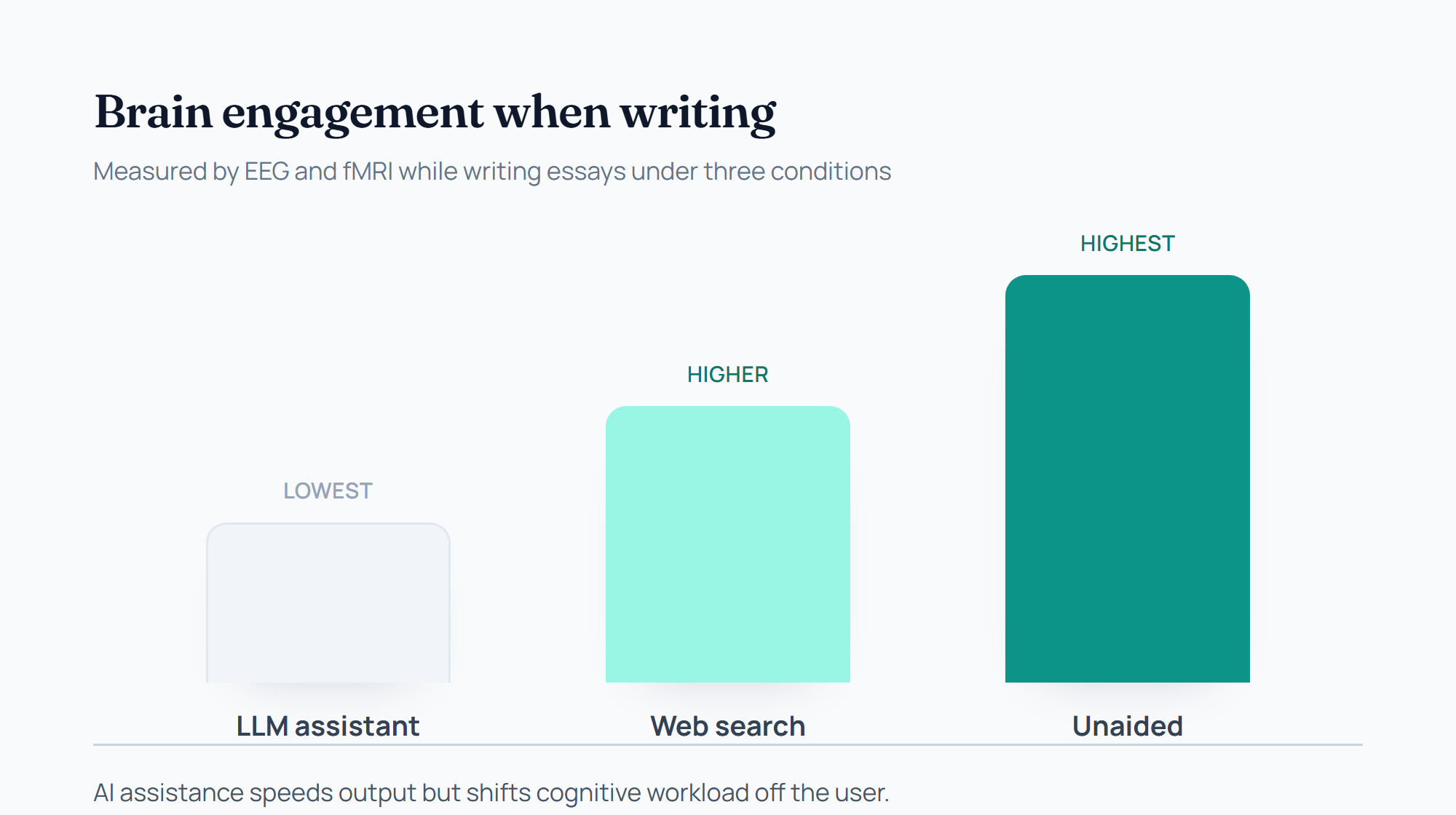
Brain engagement was lowest when writing with an LLM, higher with search, and highest when unaided.
The finding was consistent: brain engagement was lower when using an LLM than when using search, and lower with search than when working unaided. The takeaway is not that AI makes you less intelligent. It is that AI assistance speeds output while shifting the cognitive workload off the user. The work still gets done. It just gets done with less of you in it.
It is worth being precise here, because this topic invites overstatement in both directions.
This is evidence of reduced engagement and altered patterns of activity when people lean on AI to do mental work. That matters, because engagement is how skills are built and maintained.
This is not evidence of brain atrophy or permanent structural change. Nobody is being harmed by using a tool. Cognitive offloading is something humans have always done, and for routine tasks it is entirely sensible.
The practical response, then, is not to avoid AI. It is to be deliberate about where you keep practising:
For an individual, the cost of convenience is a personal balance to strike. For an organisation, it compounds. When whole teams offload the same judgements to the same systems, the collective skill base thins out, often invisibly, because performance looks fine for as long as the AI is available.
That is the part most AI strategies miss. We have written before about how AI built without reference to expertise can quietly erode the very knowledge it depends on. This post is the first in a short series on that problem. The next looks at the evidence that deskilling is already happening across domains, and the third sets out how to design AI systems that protect expertise rather than drain it.
Getting this right is a design choice, not an accident. If you want to think through where your organisation is offloading skill it cannot afford to lose, a fixed-fee advisory session is built for exactly that conversation.
Want to use AI without hollowing out your team’s expertise? Let’s talk.
FAQ
Cognitive offloading is the process of delegating mental tasks to an external tool or system, from using a calculator instead of doing arithmetic in your head to asking an AI assistant to draft a document. It is not inherently harmful, and it is something humans have always done. The risk comes when offloading removes the practice that keeps a critical skill sharp, so the skill quietly erodes through lack of use.
No. Studies that measured brain activity while people wrote with and without AI found lower engagement with the task when an AI assistant was used, but this is evidence of reduced effort on that task, not of brain damage or lasting structural change. The practical concern is not physical harm, it is that consistently lower engagement with a skill leads to that skill weakening over time.
The answer is not to avoid AI, but to add deliberate practice back in where a skill genuinely matters. Use AI for routine work, keep practising the judgements that define your expertise, and build verification checkpoints into your workflow so you stay engaged with the reasoning rather than simply accepting the output.
Keep reading
From medicine to aviation to driving, the same pattern recurs: skills that are not practised atrophy, even among highly trained …
Read insightMost AI is designed to optimise tasks. But when it's built without reference to the expertise behind those tasks, it doesn't just fail to …
Read insightAI systems do not have to erode human skill. Designed deliberately, they can preserve and even strengthen it. Six practical design patterns, …
Read insightWhere this goes
The ideas in this writing are becoming products. The waitlist is the earliest way in. For a deeper conversation about your situation, we hold a small number of fixed-fee advisory sessions each month.
New insights are shared on LinkedIn as they publish.