
Which Doors Should Machines Walk Through?
Jeff Bezos's test of one-way and two-way doors maps neatly onto where to let AI act alone. The twist is that automation reshapes which door …
Read insightAI systems do not have to erode human skill. Designed deliberately, they can preserve and even strengthen it. Six practical design patterns, and the continuum that tells you where to keep practising.
The first two posts in this series made an uncomfortable case: AI can quietly erode the very expertise it depends on, and across domains that erosion is already happening. It would be easy to read that as an argument against AI. It is not.
AI systems do not have to deskill the people who use them. That outcome is the result of design decisions, usually unexamined ones. Make different decisions and the same technology can preserve expertise, and in some cases actively strengthen it. This post is about those decisions.
There is no single switch that makes AI preserve skill. There is, however, a set of patterns that consistently push in the right direction.
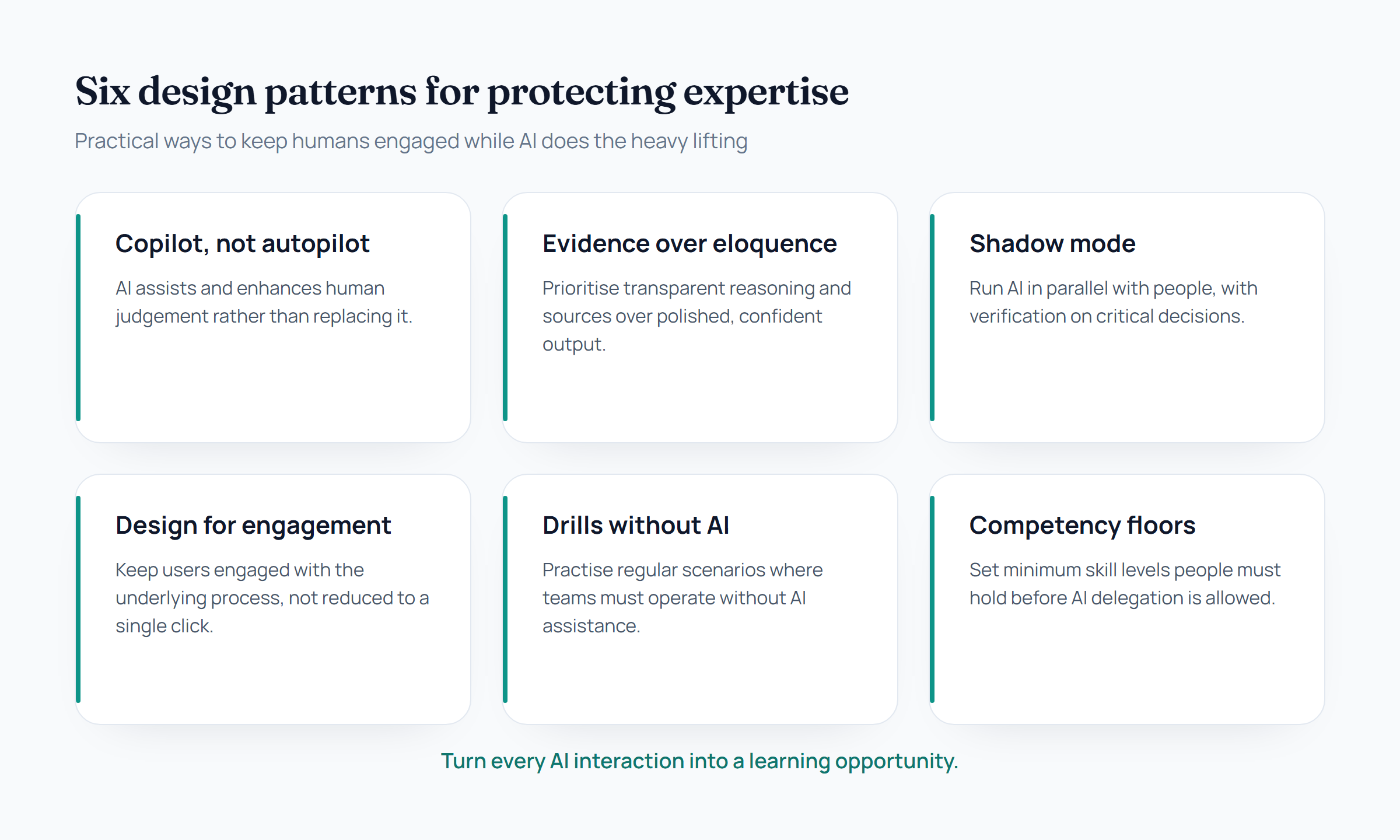
These are not mutually exclusive. The strongest systems use several at once.
The difference this kind of design makes is easiest to see at the level of a single interaction.
A black box interface says: “Here is your analysis result. Click to accept.” The user learns nothing, and over time learns to stop thinking.
An interface designed for engagement says: “Here is your analysis, with the reasoning steps. Senior analysts typically check these three factors. Why do you believe this result is correct? What assumption, if wrong, would change your conclusion?” The same answer is delivered, but the interaction now teaches.
Four principles turn an AI interaction into a learning opportunity:
Underpinning all of this is explainable AI: systems that make their reasoning transparent and interpretable instead of handing down opaque outputs. The principle is simple. Understanding the reasoning is as important as the answer itself, because reasoning is what can be taught.
Explainable AI must teach while it assists. When users can see causal reasoning chains, transparent rules, explanations grounded in concepts, and the points where human validation is required, they can do three things they cannot do with a black box: validate the output, trust it appropriately, and learn from it. That is knowledge transfer happening as a natural part of normal work.
Of the six patterns, competency floors are the one most often missing, and the one that most directly protects continuity. A competency floor defines the minimum manual capability each role must keep, so the team can still function when AI is unavailable or wrong.
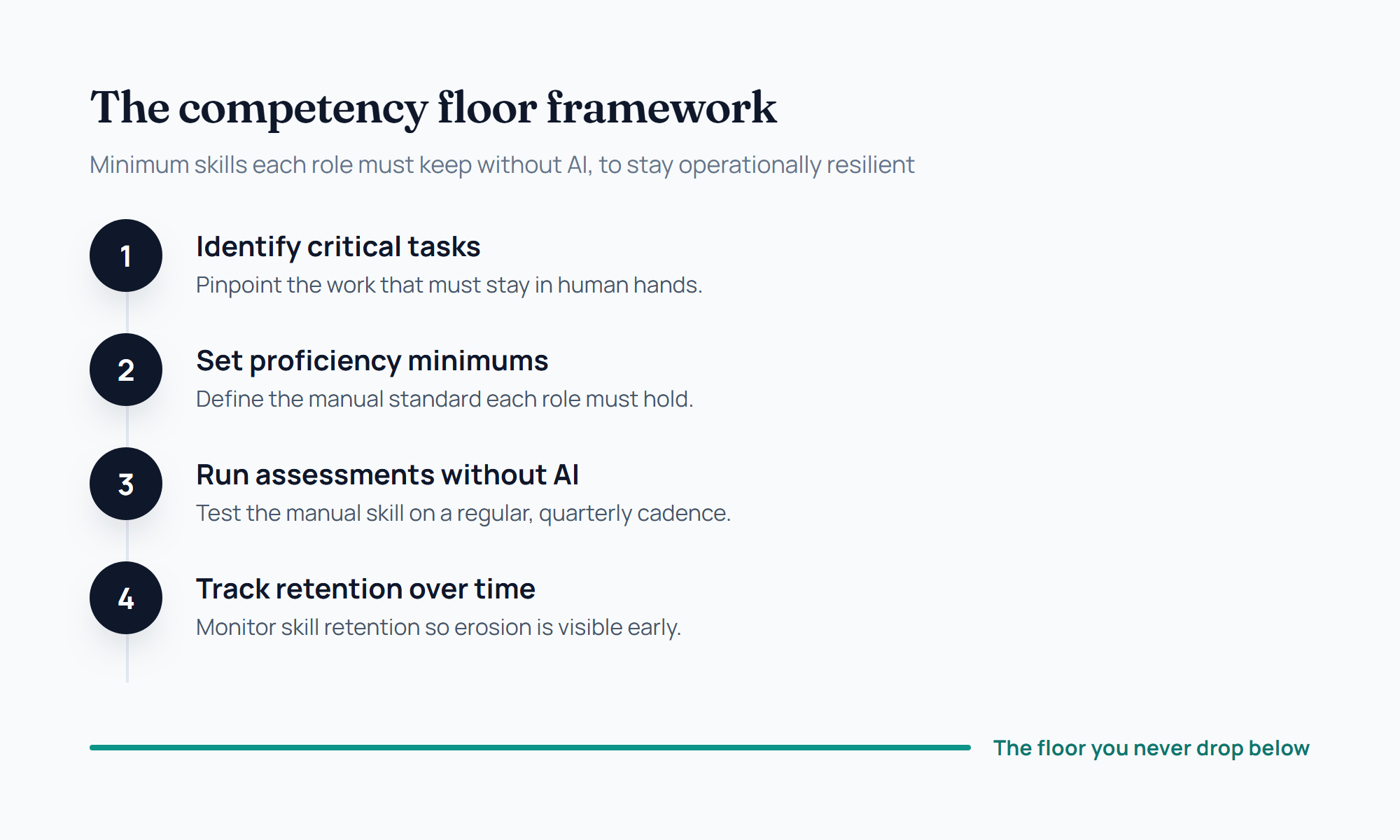
Treating that baseline as something you measure and defend, rather than assume, is what keeps skill erosion visible before it becomes a crisis.
Here is where design stops being purely defensive and starts compounding in your favour. One of the most effective knowledge capture patterns we have seen comes from work documented by Intel, in which subject experts correct AI outputs and those corrections become structured knowledge maps for other teams.
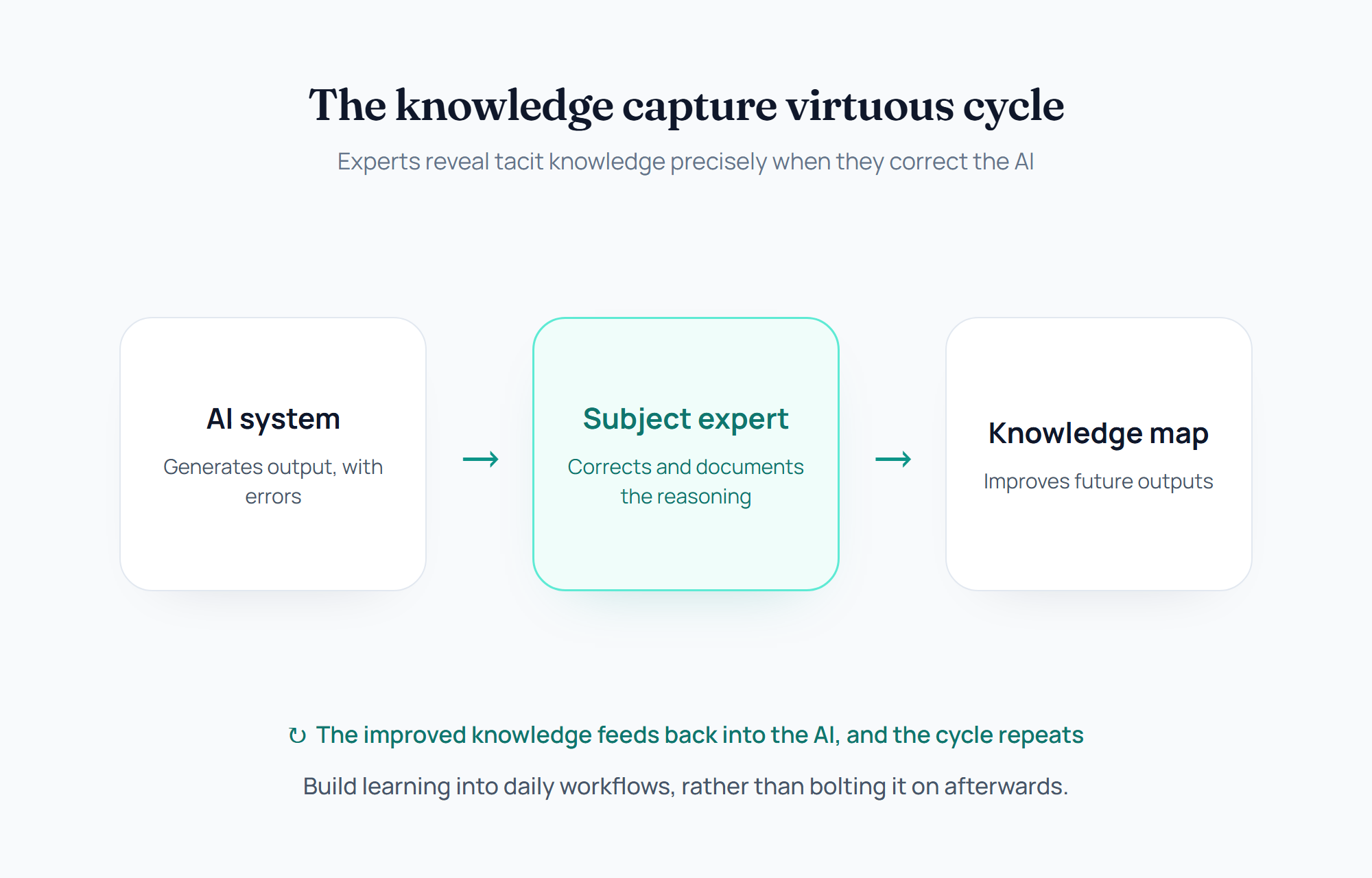
The insight is subtle but powerful: experts reveal their tacit knowledge precisely when they correct an AI’s mistakes. Tacit knowledge is notoriously hard to document through traditional methods, but it surfaces naturally through the act of correction. Build the capture into the daily workflow, rather than bolting it on afterwards, and you create a cycle where the AI improves while your institutional expertise is documented at the same time. This is the constructive flip side of the knowledge problem we explored in AI for knowledge transfer, and it pairs naturally with structured approaches like the LLM Wiki pattern.
None of this means keeping a human in the loop for everything. As AI capabilities expand, we will and should delegate increasingly complex tasks. The real decision is not whether to delegate, but where to keep practising.
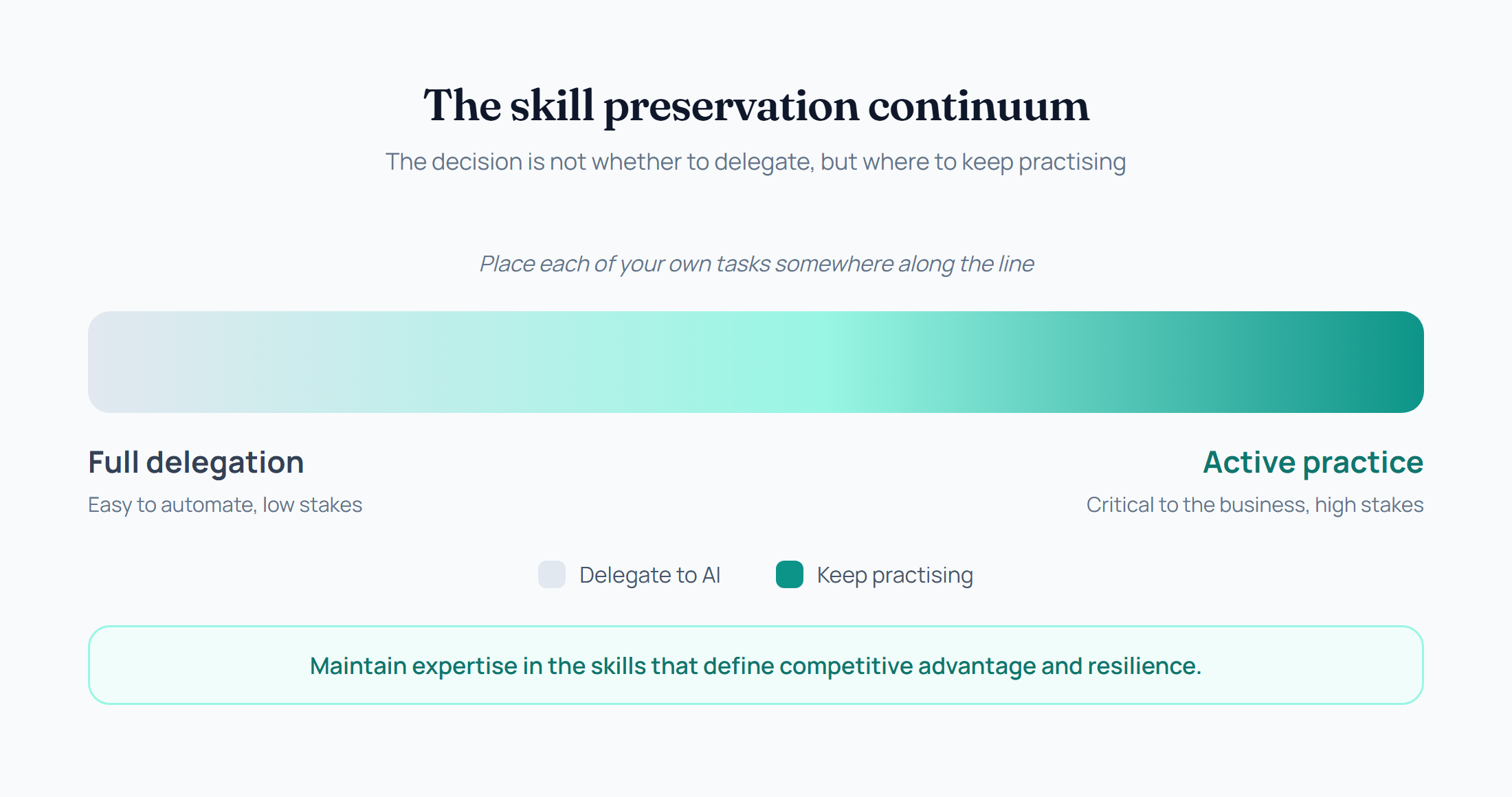
Some tasks belong with the AI. Others are too central to your advantage and resilience to let atrophy.
Plot your work along two axes, how easy it is to automate and how critical it is to the business, and the answer becomes clearer. Routine, low stakes work can be delegated freely. The judgement that defines your competitive edge, and the decisions where a mistake is costly, are the skills to keep actively practising, whatever the AI is capable of. This is the same principle of keeping a human in the loop, applied across an entire portfolio of tasks.
Designed carelessly, AI takes the work and the skill with it. Designed deliberately, it does the work and deepens the expertise of the people who use it. The difference is entirely in the design, and the organisations that get it right gain both efficiency and resilience, rather than trading one for the other.
Building this kind of system is the heart of what we think and write about. If you want to design AI that strengthens your team’s expertise rather than draining it, a fixed-fee advisory session is a good place to start.
Ready to design AI that protects your expertise? Let’s talk.
FAQ
By treating skill retention as a design requirement rather than an afterthought. In practice this means building AI as a copilot rather than an autopilot, prioritising transparent reasoning over polished answers, keeping humans engaged with the underlying process, practising regular scenarios without AI, and setting minimum competency levels people must hold before they are allowed to delegate to the system. The goal is for every AI interaction to be a learning opportunity, not just a shortcut.
A competency floor is the minimum level of manual skill that a person in a given role must maintain without AI assistance, so that the team can still operate when the system is unavailable or wrong. Establishing one involves identifying the critical tasks that must stay in human hands, setting proficiency minimums per role, running regular assessments without AI, and tracking skill retention over time so that erosion is visible early rather than discovered during a crisis.
Explainable AI makes a system's reasoning transparent and interpretable, so users can understand, validate, and learn from how it reached an answer rather than just receiving the answer. It matters for skill retention because reasoning that is visible can be taught: when people see how a decision was reached, the assumptions, and the failure modes, the AI becomes a teacher as well as an assistant, and expertise is transferred rather than hidden inside a black box.
Keep reading
Jeff Bezos's test of one-way and two-way doors maps neatly onto where to let AI act alone. The twist is that automation reshapes which door …
Read insightFrom medicine to aviation to driving, the same pattern recurs: skills that are not practised atrophy, even among highly trained …
Read insightAI delivers real productivity gains, but relying on it to do our thinking quietly reduces the mental engagement that builds and maintains …
Read insightWhere this goes
The ideas in this writing are becoming products. The waitlist is the earliest way in. For a deeper conversation about your situation, we hold a small number of fixed-fee advisory sessions each month.
New insights are shared on LinkedIn as they publish.