
The Cognitive Cost of Convenience
AI delivers real productivity gains, but relying on it to do our thinking quietly reduces the mental engagement that builds and maintains …
Read insightFrom medicine to aviation to driving, the same pattern recurs: skills that are not practised atrophy, even among highly trained professionals. The business risk follows close behind.
It is tempting to treat the deskilling AI can cause as a future risk, something to worry about once the technology is more capable. The evidence says otherwise. Across very different fields, driven by the same human factors, the erosion is already measurable. The lesson from each domain is the same one, dressed in different clothes.
Deskilling is rarely dramatic. It shows up in four recognisable ways:
The first three are warning signs. The fourth is the underlying disease.
This is not theoretical. The same effect appears wherever capable automation meets skilled human work.
Different professions, different stakes, one pattern. Cognitive and procedural skills follow a simple rule regardless of domain or expertise level: use it or lose it.
Read across the evidence and the trajectory is strikingly consistent. Performance with AI follows a predictable curve: an initial improvement as the tool takes load off the user, followed by growing dependency, followed by erosion of the skill underneath. Early work also suggests this degradation accelerates under time pressure, precisely the conditions where AI is most tempting to lean on and where lost skill is most dangerous.
The highest risk sits where the stakes are high, where errors carry significant consequences and AI assistance is becoming common at the same time. That combination, serious consequences plus thinning human skill, is exactly the one organisations cannot afford to drift into unmonitored.
There is a further effect that is easy to overlook. Junior positions have always done double duty: they get work done, and they build the foundational skills that produce tomorrow’s experts. When AI quietly absorbs that junior work, the immediate output looks fine, but the development pathway disappears.
Follow that logic forward and you get a familiar, avoidable failure:
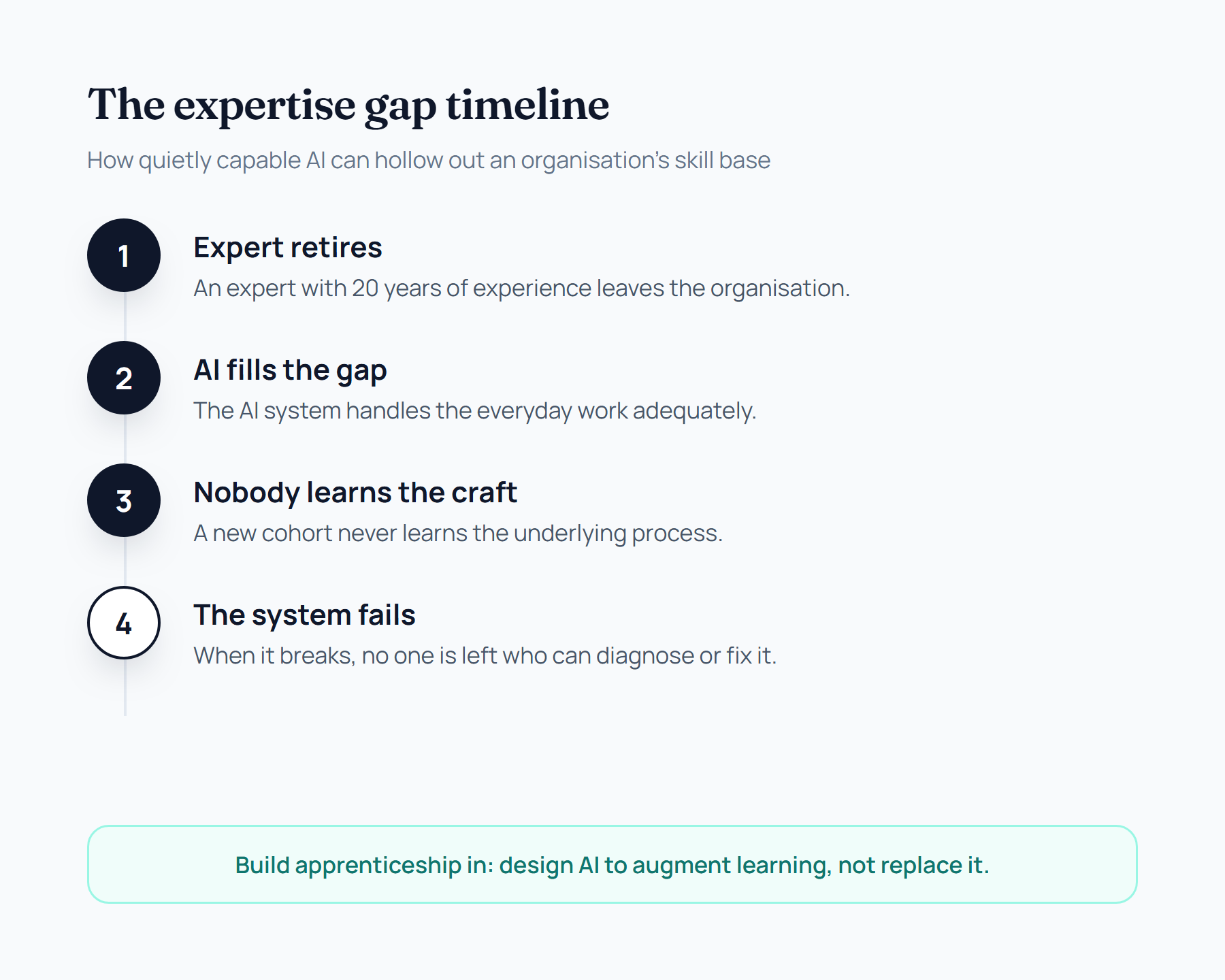
The expertise gap timeline. Each step looks reasonable in isolation. The endpoint is a system no one understands.
The way out is to build apprenticeship back in: design AI so that it augments learning rather than replacing it, and protect the practical experience that turns juniors into experts.
Here is the part that moves this from an interesting research finding to a concern for the board. AI presents a genuine paradox: the same technology that can capture and preserve expertise can also be the cause of its erosion.
The opportunity is real. As experts correct AI, their tacit knowledge can be captured, documentation can emerge from daily workflows, and institutional memory can become searchable and transferable. We have written about that upside in AI for knowledge transfer.
But the risk runs in parallel. Skills atrophy without practice. Experts retire without successors. Teams lose the ability to validate what the AI tells them. And the capacity to innovate, which depends on deep human understanding, quietly diminishes.
The conclusion is blunt: without skill continuity, there is no business continuity. An organisation that has outsourced its critical judgement to a system it can no longer check has not become more efficient. It has become more fragile.
This is the second post in our series on AI and human expertise. The first looked at the cognitive cost of convenience and the research behind it. The third turns to the practical question: how to design AI systems that protect expertise rather than drain it.
If you want a clear view of where your organisation is most exposed to skill erosion, a fixed-fee advisory session can map your specific situation.
Concerned about deskilling in your own teams? Get in touch.
FAQ
Deskilling is the gradual deterioration of cognitive and procedural skills that are no longer regularly practised because an automated system handles them. With AI, performance often holds up well while the system is available, then drops sharply when it is removed, which reveals that the underlying human skill has quietly eroded. It affects highly trained professionals as readily as anyone else, because the mechanism is simply lack of practice.
Automation bias is the tendency to place too much trust in an automated system and stop checking its output independently. It leads to two kinds of error: omission, where a person misses a problem because the system did not flag it, and commission, where a person follows an incorrect recommendation against their own better judgement. In controlled trials, diagnostic accuracy has been shown to fall when professionals were shown biased model recommendations.
Junior roles traditionally build foundational skills through practical repetition. When AI takes over those tasks, the work still gets done, but the next generation never develops the underlying competence. Over time this creates an expertise gap: experienced people retire, AI covers the everyday work, and eventually no one is left who can diagnose or fix the system when it fails. Avoiding this requires deliberately designing learning paths that keep people practising directly.
Keep reading
AI delivers real productivity gains, but relying on it to do our thinking quietly reduces the mental engagement that builds and maintains …
Read insightAI is widely used to process existing information. Its potential to capture expertise that was never documented in the first place is …
Read insightMost AI is designed to optimise tasks. But when it's built without reference to the expertise behind those tasks, it doesn't just fail to …
Read insightWhere this goes
The ideas in this writing are becoming products. The waitlist is the earliest way in. For a deeper conversation about your situation, we hold a small number of fixed-fee advisory sessions each month.
New insights are shared on LinkedIn as they publish.